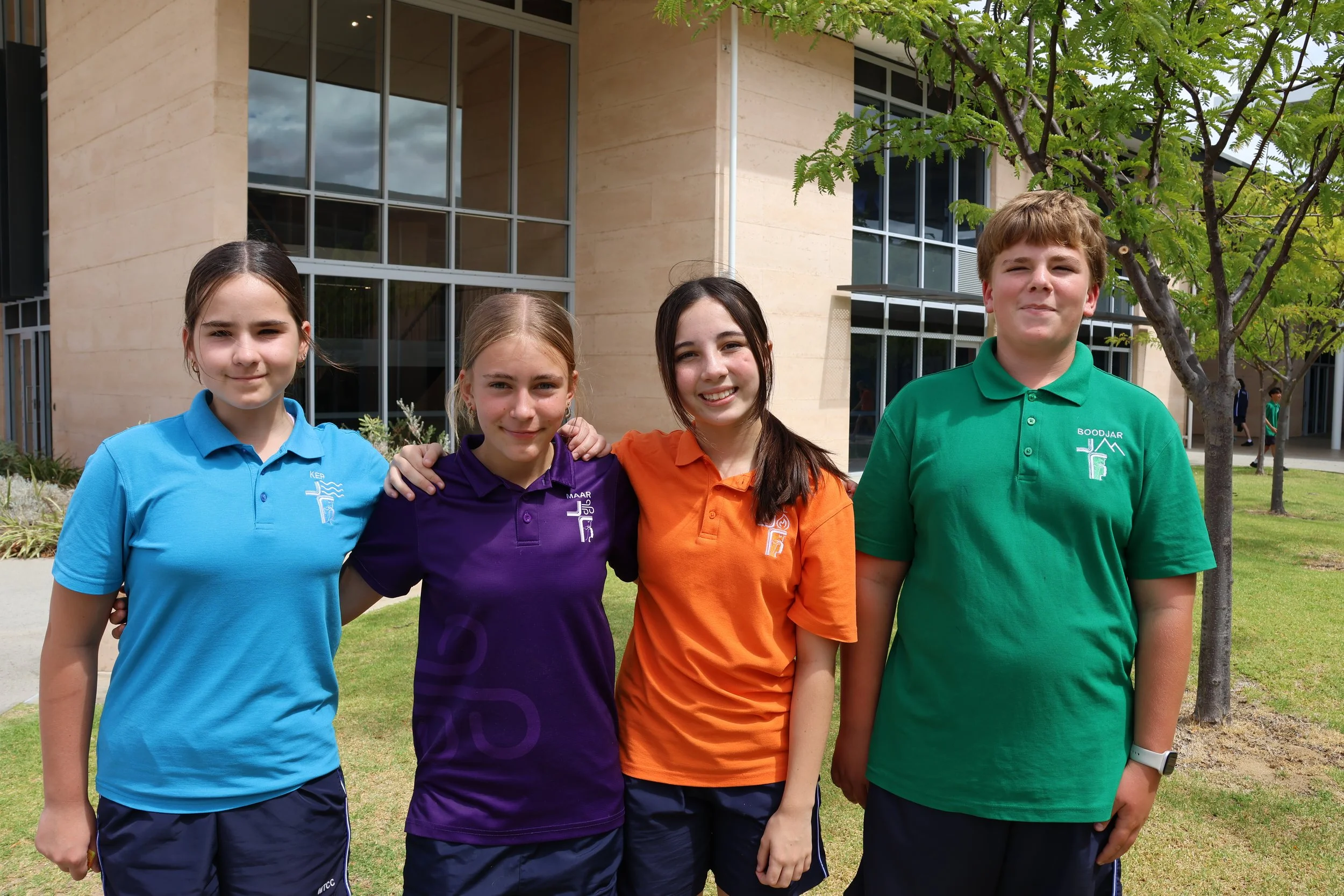
COLLEGE HOUSES

BOODJAR (LAND)
Nyoongar people believe that Boodjar (the land) and everything upon it were created by giant spiritual beings who travelled across the universe and shaped the earth. As these ancestral spirits moved across Country, they formed the hills, valleys, rivers, rock formations and waterways that remain today. When their journey ended, they became the plants, animals and living systems that continue to sustain life. Because of this, the land is sacred and alive and Nyoongar people have carried the responsibility of caring for Boodjar for countless generations.
Different Nyoongar family groups were custodians of specific areas, each holding deep cultural meaning. Every hill, river, estuary and stretch of coastline carries stories that have been passed down through families for centuries. These stories guide how people care for sacred sites, waterways and habitats, ensuring that the land remains healthy and continues to provide food and shelter for humans, animals, birds and insects.
Across the Rockingham region, Nyoongar families traditionally travelled between wetlands and woodlands, drawn by the abundance of food and fresh water. Lake Richmond was an important gathering and camping place. Lake Cooloongup and Lake Walyungup hold special Dreaming significance as places connected to the Sea Waugal. Paganoni Swamp is also culturally significant, with an Aboriginal burial site nearby.
Nyoongar people believe that when sacred places are protected, forests remain healthy and waterways flow strongly, Boodjar will continue to provide into the future. The land’s survival follows the rhythm of the six seasons, guiding fishing, gathering and renewal. After Kaal (fire), green shoots and bush foods regenerate, showing the resilience and strength of Boodjar and its enduring ability to sustain all life.
KAAL (FIRE)
The use of Kaal (Fire) by our ancestors over the centuries continues to be an important cultural practice that has been adopted by the wider community as an effective land fire management practice.
For the Nyoongar people of south-west Western Australia, Kaal is more than just fire. It is a living part of Country, a tool given by ancestors, and a responsibility carried through generations.
Long ago, Elders would watch the land closely. They would feel the direction of the wind, notice the dryness of the grasses, and read the signs of the six seasons. When the time was right, often during Birak, they would light small, cool fires that moved gently across the ground. These fires did not rage or destroy. They crept softly, clearing old growth, returning nutrients to the soil, and making space for fresh green shoots to rise.
As the new plants grew, animals came to feed, and the people followed. In this way, Kaal helped provide food and kept the land healthy. It reduced thick undergrowth so that when lightning struck or the heat of summer came, the fires would not burn fiercely and out of control. The land was protected because it had already been cared for.
Children learned by watching and listening. They were taught that fire must never be used carelessly. Kaal carried power, and with power came responsibility. It was part of culture, law and identity — a reminder that people belong to the land, not the other way around.
Today, many are beginning to understand what Nyoongar people have always known: that fire, when used with knowledge and respect, heals Country instead of harming it. Through Kaal, the old ways continue to guide the present, keeping the land strong for future generations.
KEP (WATER)
Water, known as Kep, is essential to survival. It sustains humans, animals, birds, plants and insects. During Djeran, Makuru and Djilba, the cooler and wetter months, Kep is abundant. Seasonal rains nourish the soil, fill rivers and recharge underground water systems in preparation for the hot summer months.
For countless generations, the availability of Kep has supported ecosystems across the region. Nyoongar people, as custodians of the land, hold an ongoing responsibility to protect water sources and manage resources wisely.
Nyoongar people believe in the Nyitting, or Dreaming, the time of creation when ancestral spirits formed the land and all living things. During this time, powerful beings shaped the earth, sky and waters, laying down the laws that guide life and culture today.
Central to this belief is the Wagyl, the rainbow serpent who travelled across the land and sky. As the Wagyl moved, it created koondarnangor (thunder) and babanginy (lightning), calling in boorong (rain). The Wagyl is the giver of life, responsible for creating and protecting fresh waterways such as bilya/beeliar (rivers), pinjar (estuaries, swamps and lakes) and ngamma (waterholes). As it slithered across the earth, including the Darling Scarp, it formed waterholes, sand dunes, bays and lakes that remain today.
Nyoongar people believe that without the Wagyl there would be no fresh water. Elders teach the importance of respecting water sources, ensuring they remain clean for drinking, cooking and cleansing. Children were warned not to swim in muddy water, as this signalled that the Wagyl was feeding and the place was spiritually active.
By respecting the teachings of the Nyitting and the life-giving presence of the Wagyl, they ensure that water — and life itself — continues for future generations.
MARR (Wind)
In Noongar culture, Maar represents the wind—a powerful force that brings life, balance and renewal to Boodjar (Country). For countless generations, Noongar people have understood that everything on Earth is connected, and that the movement of Maar helps shape the seasons and guides how people live in harmony with Country.
When Maar is still, it is seen as a warning. Without the cooling winds, the land becomes hot and dry, and Kep (water) begins to disappear. Plants, animals, birds, reptiles and insects struggle to survive, reminding people of the importance of caring for Country and knowing when it is time to move to safer places.
At times, Maar can carry Kaal (fire) across the landscape, bringing destruction to trees, grasslands and the homes of wildlife. Yet even in this, there is renewal. As the wind moves across the land, it also carries seeds that take root and create new life. Fresh growth follows, nourishing the soil, providing food for wildlife and restoring the balance of the natural world.
Through ceremony and song, Noongar people honour Maar for its role in sustaining life—bringing oxygen to the trees, cooling the land and maintaining the delicate balance that allows all living things to thrive. Maar reminds us that even after hardship, nature has the power to heal, regenerate and begin again.